
Motor start/stop ladder logic with a seal-in circuit
The seal-in circuit is the first rung most people learn. A momentary Start button turns a motor on, and the motor's own contact keeps it on after the button is released. Stop breaks the rung and the motor drops out.
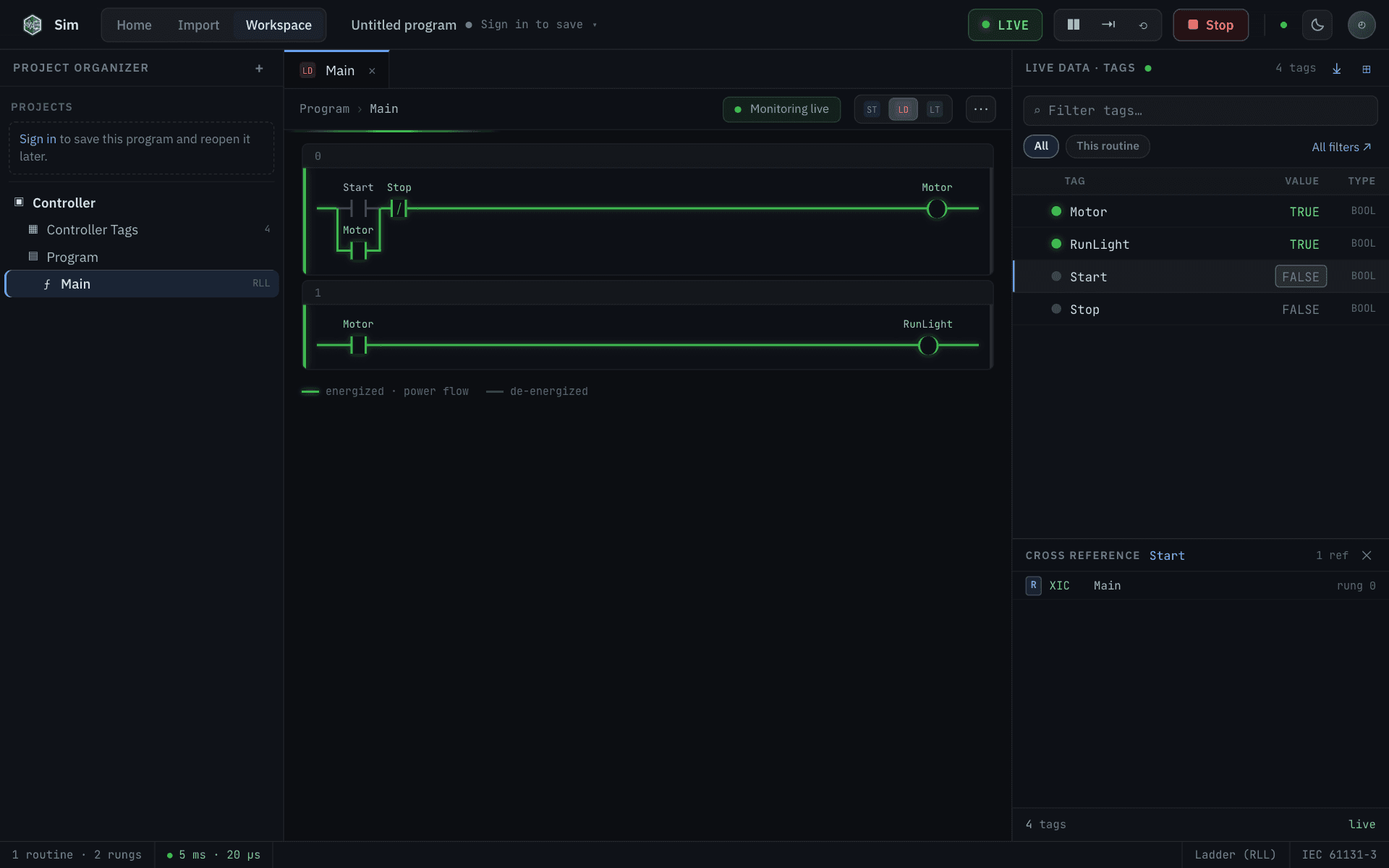
The program
[XIC(Start),XIC(Motor)]XIO(Stop)OTE(Motor);
XIC(Motor)OTE(RunLight);
How it works
Rung 0 puts Start in parallel with a contact on Motor itself. Press Start and the top path closes. Power reaches XIO(Stop), which passes it on while Stop is not pressed, and OTE(Motor) energizes.
On the next scan you can let go of Start. The lower branch is now true, because Motor is on, so the rung stays true. The motor has sealed itself in through its own contact.
Press Stop and XIO(Stop) goes false. The rung goes false, Motor de-energizes, and the seal-in contact opens with it. Releasing Stop restarts nothing, because neither branch is true any more. Stop sits in series after the branch, so it always wins over Start.
Rung 1 is a pilot light. RunLight follows Motor.
In this program Stop is 1 while it is pressed. On a real panel a stop button is usually wired normally closed, so a broken wire stops the machine, and the rung would test it with XIC instead. The idea is the same with the contact flipped.
Try this
In the simulator, an input changes when you click it in the tag list: click once to turn it on and again to turn it off. To press a button, turn it on; to release it, turn it off; to pulse it, do both.
- Press Start and release it. Motor stays on. That is the seal-in.
- Hold Stop and press Start. Nothing happens. Why does Stop win?
- With the motor running, press Stop. Motor and RunLight both drop out and stay out after you let go.
Tags
| TAG | ROLE |
|---|---|
| Start | BOOL input. Momentary start push button. |
| Stop | BOOL input. Stop push button, 1 while pressed. |
| Motor | BOOL output. The motor contactor, and the seal-in contact. |
| RunLight | BOOL output. Pilot light that follows Motor. |
More examples
Conveyor with dwell
Ladder (NT)The belt runs, a 5-second timer gives it time to get up to speed, and only then does the ready lamp light. Watch the accumulator climb.
Traffic light sequencer
Structured TextThree chained timers cycle forever with no input. Press Run and watch it go.
Read more about the ladder logic simulator, or see all examples.